Wellington Regional Science Fair prize for 2026
This year’s winner of the Royal Society of New Zealand Wellington Branch Science Fair prize for the runner-up best overall exhibit, was Year 9 student, Purav Joshi, of Wellington College. David Lillis made the award at the Science Fair Awards Ceremony at Victoria University on Saturday 29 August.
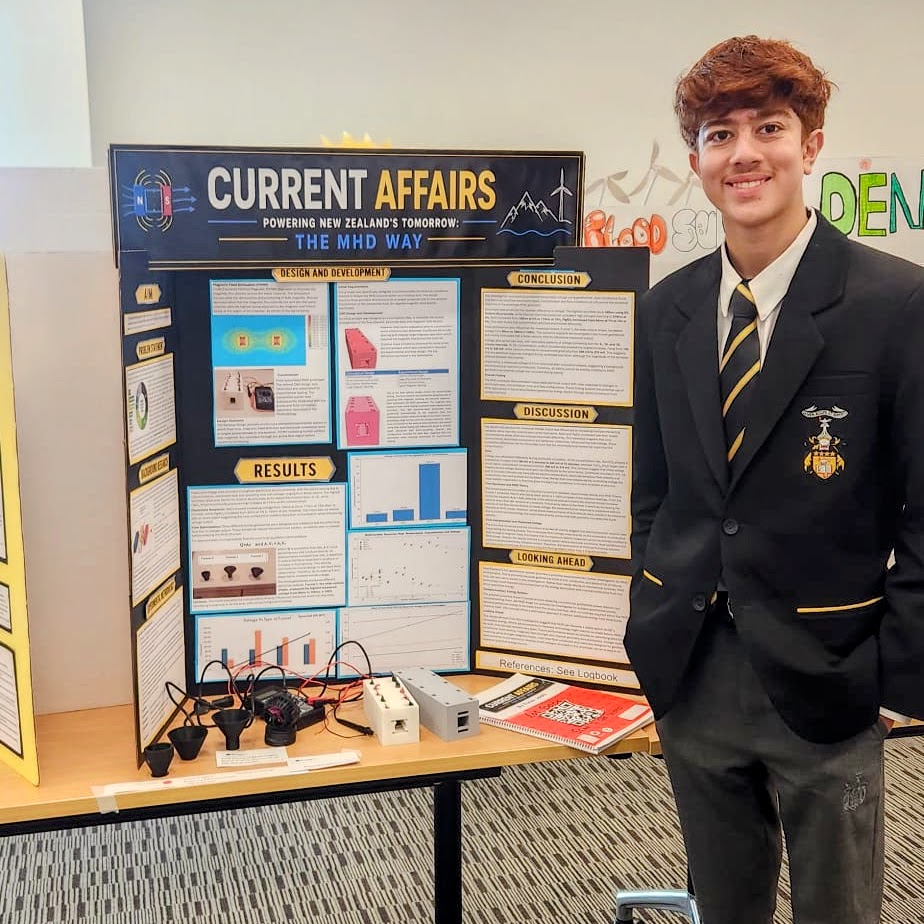
Current Affairs: Powering NZ’s tomorrow - The MHD Way
Here is Purav’s description of his project.
My project investigated magnetohydrodynamics (MHD) as a possible alternative for generating additional geothermal energy. New Zealand already generates a significant amount of energy from geothermal energy, where hot, fast-moving fluids move through geothermal systems. This made me wonder if New Zealand can recover additional electricity directly from these moving fluids.
MHD occurs when an electrically conductive fluid moves through a magnetic field. The ions within the fluid experience the Lorentz force and interact with the magnetic field, causing charge separation and producing a voltage across electrodes.
I designed and built a small-scale MHD generator using neodymium magnets, stainless-steel electrodes and a circulating fluid tank. After evaluating my original prototype, I redesigned the system to improve the magnetic-field arrangement and electrode configuration, using Finite Element Magnetics Method (FEMM) computer simulation to help simulate the magnetic field.
My investigation tested different electrolytes across multiple concentrations, while also examining the effects of temperature, operating time and flow conditions. I designed three different funnel geometries to investigate how changing the fluid-flow conditions affected voltage generation.
My results showed that measurable voltage could be produced and that the electrical response depended on a combination of electrolyte composition, concentration and flow conditions, rather than one factor alone. The project suggests that MHD could be investigated further as a complementary energy-recovery technology, potentially recovering additional electrical energy from conductive fluids already flowing through New Zealand's geothermal infrastructure and helping improve its renewable energy systems overall.
.

Wellington Regional Science Fair prize for 2024
Our winner is Reese Lingad in Year 9 at Upper Hutt College.
SmartTrash: Training AI to Identify Common Recyclables
"My aim with the project was to train an Artificial Intelligence to recognise and sort recyclable and non-recyclable objects into different categories.
I specifically selected a small data set - pictures of paper cups, cans, and plastic bottles - to train an AI model using Lobe, a Microsoft program.
Then, I created the SmartTrash machine from a shoebox, Raspberry Pi camera, LEDs, resistors, wires, and a Raspberry Pi small computer.
Using Python, I created a program that accesses the camera, LEDs and the AI model; automatically takes pictures of objects inside the box; determines what recyclable it is using the model; and lights up the corresponding LED from the AI prediction.
The main takeaway from my tests is that AI is not perfect and although the SmartTrash's accuracy got up to 88.5%, one would need very large databases to truly achieve 100% accuracy.
My project may have many applications in everyday life; for example, integrated into public trash bins or recycling plants; or to automatically detect groceries in physical store carts or products in vending machines."

NIWA SCIENCE FAIR PRIZE FOR 2023
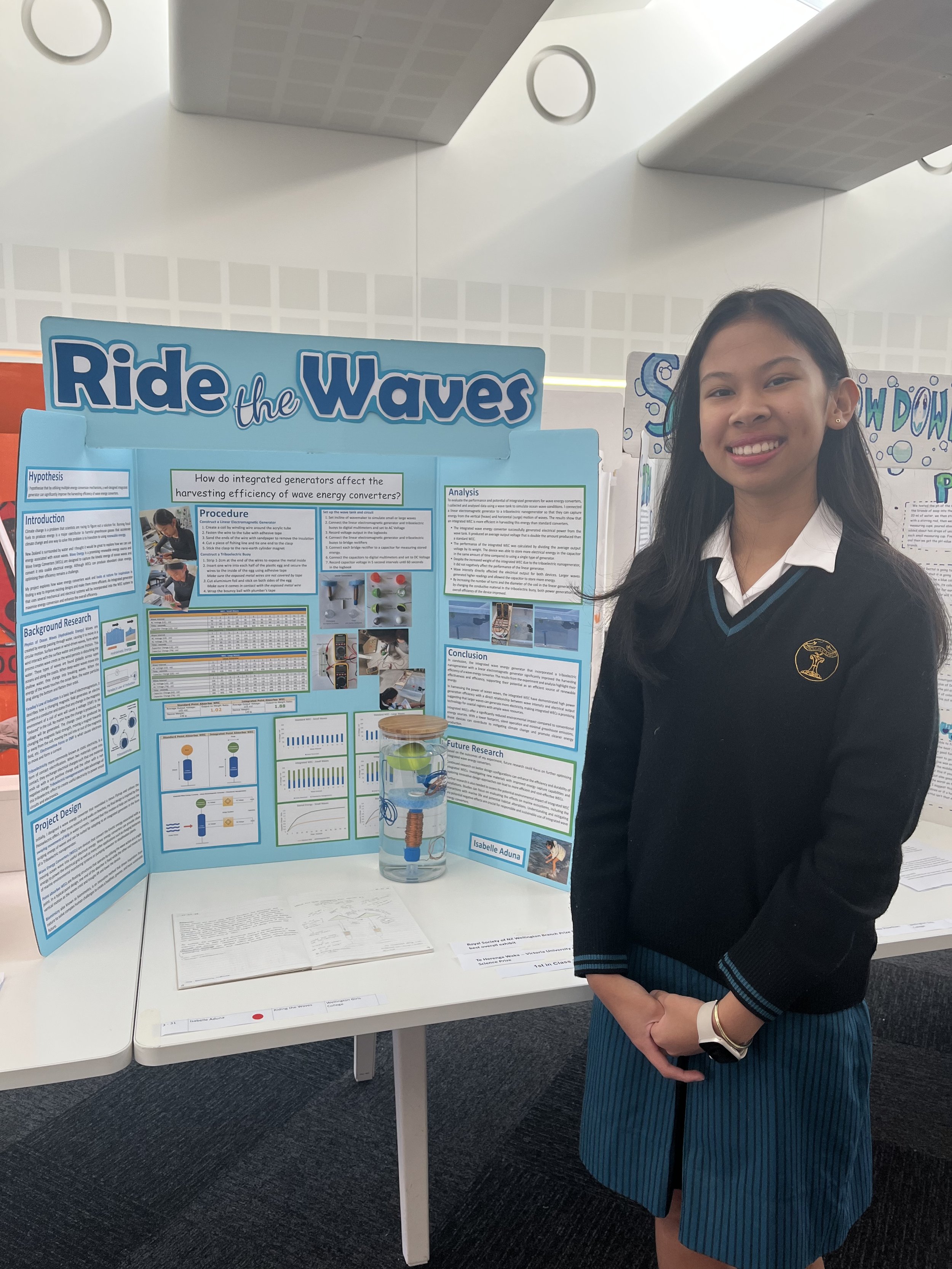
The 2023 NIWA Wellington Science and Technology Fair Award Ceremony was very successful - as always! Every year, the Wellington Branch provides a prize for the Runner up Best Overall Exhibit. Our winner this year was Isabelle Aduna, a Year 9 student from Wellington Girls’ College. Isabelle’s project was called “Riding the Waves”, and was about exploring wave energy converters and integrated generators. Her prize of $750 was presented at the Award Ceremony, held on Saturday 2 September at 1:00 pm, Te Toki a Rata Lecture Theatre 1, Victoria University of Wellington, Old Government Buildings.

NIWA SCIENCE FAIR PRIZE FOR 2022
This year the Branch awarded a prize of $750 for overall runners-up. Our winners were Kaita Hummel-Jibiki and Simon Langham from Tawa College. David Lillis presented the prize at the award ceremony, held on Saturday 27 August at Victoria University of Wellington, Old Government Building.
Kaita Hummel-Jibiki and Simon Langham are year twelve students at Tawa College. Their project used microbes as bio-indicators of water quality. They say that they are looking forward to studying science in the future. Here is their summary:
Their project, called Resilient Rotifers, focused on constructing a rudimentary way of analyzing water samples via rotifers found in the water. Rotifers are microscopic aquatic invertebrates that are found worldwide. Their physical appearance and characteristics, along with their quantity in certain samples, are so great that they are perfect for use as bio-indicators of water quality. By searching over 12,900mm2 for samples from various populations, they formulated a comprehensive data report which allowed them to identify specific patterns. These patterns were so prominent that a simple flowchart could be constructed. A user would be informed of the approximate pH-level, salinity-level, oxygen-level, nutrient-level, and many more key characteristics of their sample, all on the basis of the quantity and quality of rotifers found in their samples.
niwa science fair prize
We award a prize of $500 to the runner-up in the annual Wellington Regional Science Fair. This year (2021) we awarded our prize to Emma Bateson, Imogen Bell and Liang Dajnowski of Saint Oran’s College for their project entitled “All About the Bays”.
Emma, Imogen and Liang carried out a rocky shore survey at Houghton Bay and Owhiro Bay. The diversity of organisms was compared between bays, synthetic surfaces and rock pools. This data was compared with previous records when the area was polluted with sewerage.

Liang Dajnowski, Emma Bateson and Imogen Bell