History of the Wellington Branch of the Royal Society Te Apārangi.
This year is the 175’th Anniversary of the Society, founded as “the New Zealand Society” in 1851.
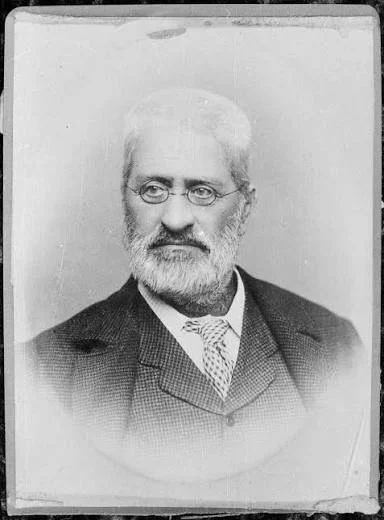
Walter Baldock Durrant Mantell (11 March 1820 – 7 September 1895)
The History of the Branch provides a glimpse into the development of science in the new colony, about as far away from the United Kingdom as it was possible to be.
A news item in the Wellington Independent newspaper for 2 July 1851 reads in part:
“We are glad to hear that an attempt is about to be made to establish a society similar to the Royal Society of Van Diemens Land and several parties have, we understand, been requested to become members and a meeting has been called for this evening in the Athenaeum”.
The “request” mentioned was from the then governor of the colony, Sir George Grey, and at that meeting in the “Athenaeum and Mechanics building” in Lambton quay, Wellington “The New Zealand Society” was duly formed, with Governor Grey as the President.
The origin of the “New Zealand Society” is a separate subject that needs more research. A letter written by a Mr A. P. Holroyd, dated 17 August 1844 and quoted in Louis E. Ward’s 1928 publication - “Early Wellington”, provides evidence that a “New Zealand Society” already existed in England in the 1840’s with the object to promote life in the colony, and that it was intended to establish one or more branches in New Zealand. Ward also notes that the Hon Walter Mantell, first Post Master, Superintendent of Military Roads, Commissioner for native Claims and in 1951 the Crown Lands Commissioner, “assisted in the formation of the N.Z. Society for Scientific Purposes, 1851. ”
Its worth noting that the Athenaeum and Mechanics building in Lambton quay where the meeting was held was, in 1851, a brand new masonry building, built the year previously to replace a simple Raupo (Typha orientalis, a native bulrush) hut that was demolished after the government instituted an annual levy on Raupo buildings because they were highly inflammable.
The new Athanaeum was already being used for science lectures, for example, in 1850 newspaper records show lectures were held in November and December on Electro-Magnetism and Terrestrial Magnetism. The lectures were advertised as “Free to members of the Athenaeum and free for ladies, but one shilling for non-members”.
These public lectures illustrate how during New Zealand’s colonial era people of all walks were very interested in universal science and new developments. Scientific societies, generally called philosophical societies were springing up throughout the commonwealth, though membership of the societies tended to be for the richer members of society. For example, in the 1851 rules of the New Zealand Society an individual who was interested in science and wanted to join the New Zealand Society needed to be nominated for membership by at least two members and pay an annual fee of one guinea (about a weeks wages for a trades person). Interestingly,, it was stated that ‘Ladies may be admitted as members of the Society, without ballot, on the recommendation (in the regular form) of three Members but they will have no share in the management of the Society.
Ward (1928) also records that “On the 28th November, 1851 a meeting of the New Zealand Society was held, at which Sir George Grey presided. Amongst other matters, the report that gold had been discovered at the Upper Hutt was considered”.
New members were elected; these were: Rev. R. Taylor, M. A.. Messrs. V. Smith. J. Roy, C.E.. and Lieut. Paul. 65th Regt. A collection of ores and minerals from Adelaide, South Australia, donated by Mr. J. H. Wallace: ores from Cornwall, donated by Mr. G. Hart. Captain Deck and Mr. S. E. Grimstone; and an engraving of the Moko by Mr W. B. Mantell, were received. The society was inaugurated to promote the advancement of science, literature and art, and the development of the resources of the colony. Sir George Grey was its founder and first president. (A. and N.Z. Gaz., 1/5/52 N.Z. Ency., Vol. 1., p. 434.)”
The Wellington based “New Zealand Society” was stated by Ward (1928) to be the first scientific society formed in New Zealand, in 1851.
The Nelson Branch of the Royal Society Te Apārangi also claim the title of the oldest branch in that their society (called the “Literary and Scientific Institution of Nelson”) was formed while still on the ship “Whitby” in May 1841 with Captain Arthur Wakefield and crew of the New Zealand Company’s ships, the “Whitby” and the “Mary Ann” as members. The Society actually preceded the settlement of Nelson by 5 months. So it could be argued that their society was not founded on New Zealand soil.
The New Zealand society met regularly until Grey left the colony in 1853, at some time thereafter it stopped holding regular meetings, though it was not dissolved and the treasurer kept the books and the bank accounts. It perhaps is significant that Walter Mantell also left for England in 1855. The society was also involved in the formation of the Colonial Museum that was opened in 1865, renamed the Dominion Museum and replaced by the National Museum (Te Papa) in 1998. The museum’s first director, Sir James Hector, was a member of the New Zealand Society and a range of “curiosities and other items collected by the NZ Society ended up in the museum. One of the “perks” of the Wellington Branch was actually having a set of meeting rooms in the old Dominion Museum by the Basin Reserve.
When Grey returned returned to the Colony in 1861, the New Zealand Society Committee dusted off the accounts and the society re-commenced its activities, formally reconstituting the society in November 1867 and changing the name in 1868 to the “Wellington Philosophical Society” to coincide with and avoid confusion with the establishment of the New Zealand Institute (now the Royal Society Te Apārangi).
The New Zealand Institute came about with the return of Governor Grey, and through the lobbying of the various regional Philosophical and science societies that had formed in the colony together with the support of prominent people such as the geologist (and member of the New Zealand Society committee) James Hector. This resulted in the passing of an Act, the New Zealand Institute Act 1867 the purpose of which was “to make provision for carrying out the geological survey of the Colony and to establish and incorporate a public institution in the City of Wellington to be called “The New Zealand Institute” which institute shall comprise a public museum and laboratory and a public library And whereas it is also expedient by means of lectures classes and otherwise to promote the general study and cultivation of the various branches and departments of art science literature and philosophy”.
A great advantage of the new Act was the financial support that it provided. The large annual budget of 500 pounds from the government was very welcome. The support of the various regional societies was recognised under the Act as “Affiliated societies” responsible for electing annually 3 governors of the new Institute. In 1869 when the Institute commenced there were four affiliated societies: The Auckland Institute; the Wellington Philosophical Society, the Philosophical Institute of Canterbury, and the Westland Naturalists’ and Acclimatisation Society. By 1897 there were 8 societies affiliated. These affiliates, known as the “branches” but now as “Regional Constituent Organisations of the Royal Society Of New Zealand” under the Royal Society of New Zealand Act 1997, Section 14. still have the right to elect one council member to RSNZ TA .
But back to the Wellington Philosophical Society (now our “Wellington Branch”). in 1868 there were some 95 paid up members. The Officers were: President. Sir George Grey, K.C.B.; Vice Presidents. Right Reverend C. J. Abraham, Bishop of Wellington and His Honor I. E. Featherston, M.D., Superintendent of Wellington. The Council were W. T. L. Travers, Esq. F.L.S.R.; Hart, Esq.; R. Pharazyn, Esq. F.R.G.S.; J. Hector, Esq., F.G.S.; J. C. Crawford, Esq., F.G.S. The Hon Secretary and Treasurer was R. Pharazyn, Esq., and the membership fee was still one guinea.
One of the benefits of the new Institute was that it published the “Transactions and Proceedings of the New Zealand Institute” and these volumes included the proceedings of the regional Societies, including that of the Wellington Philosophical Society. They are all on line and give a distinct “feel” to science in the capital of the colony as it grew and matured and the impediments that the locals had to put up with.
From the preface of Volume 1 in 1868.
“The Governors regret that two very learned and important Papers, both by Captain Hutton, viz., “On Sinking Funds,” and “Flight of Birds,” could not be printed, owing to the impossibility of procuring, in Wellington, the type for the algebraic formulæ which they contain. It is necessary also to explain, that owing to the difficulties of communicating in time, only those authors who resided in the neighbourhood of Wellington could be furnished with proofs for revision”
The Wellington Philosophical Society continued to meet and to grow in Wellington alongside the New Zealand Institute. Again in Ward (1928) there is reference to a Mr. H. K. Walshe who was Assistant Surveyor. Magnetic Surveys and a “member of the Philosophical Society’s expedition to the Chatham Islands in 1903.
It is also interesting that Māori were involved from the beginning as equals. Volume 1 (1868) records “Tareha,—Native Member in the House of Representatives for the Eastern District,—then gave a description of the Māori house, in which the meeting was assembled. His Honour the Superintendent of Hawke’s Bay interpreting. Tareha spoke as follows: “In accordance with the request made to me, I shall now give the meeting an account of this house, its history and origin. “Such a building, as this, is only erected by men holding a high position among the tribes, it is a sign of chieftainship, and the proprietor becomes a noted man. The whole tribe assist in building it when called together by the chief for that purpose. “This house was built at Tauranga, in Poverty Bay, by Rahurahi, or Lazarus, in 1845, during Governor Fitzroy’s administration. When finished, all the tribes that had an interest in it were called together to discuss their affairs. It was about the time when you Europeans introduced Christianity amongst us, consequently many important subjects were talked over. The name of the house is ‘Tehaukituranga.’ All these carved posts represent certain individuals, ancestors of mine; the lower and larger figures represent the fathers, the upper ones their sons. Most of them have their names attached, as you may observe, but the oldest names have become obliterated. “This is considered an important and valuable property among the Māoris, but misfortunes visited the land, troubles were cast upon us, the tribes were scattered, and the result is that the house now stands here.” (which is a nice 19th century way of saying “You colonists stole it”).
That was the meeting house, now in Te Papa that once stood in the former Dominion Museum, Wellington, where the Wellington Branch Society had its rooms. In 2012, as part of Rongowhakaata’s Treaty of Waitangi settlement, the New Zealand government apologised to the iwi for the forcible removal of Te Hau ki Tūranga, stating that the whare whakairo belongs to them.
In 1938 the Wellington Philosophical Society was renamed again and was incorporated as the Wellington Branch of the Royal Society of New Zealand Incorporated.
In its heyday in the 1980’s the Branch had over 400 members, with its own observatory and telescope and there were the following Sections, each with their own committee: Physics Astronomy, Archaeology. Science teaching Geology, Geophysics Biology and Young Scientists. We also instigated and originally ran the Wellington Science Fair for school children.
Because of problems with misidentification with the Parent Body and in an attempt to be more “modern” the Branch changed its name in 1995 to “Science Wellington Incorporated” and then in 2001 for reasons that are not clear, changed the name back to “Royal Society of New Zealand Wellington Branch Incorporated but membership has shrunk substantially. How times have changed, but we still exist….
In 2009 the Branch was registered as a Charitable Entity with the Charities Commission (registration number CC42176). The Branch is still a Regional Constituent Organisation of the Royal Society Of New Zealand under the Royal Society of New Zealand Act 1997, Section 14. The Branch was re-registered in 2025 as an incorporated society under the Incorporated Societies Act 2022.
Thanks for reading Brian Jones! Subscribe for free to receive new posts and support my work.
A Brief History of the Royal Society of New Zealand wellington branch
Dr. Brian Jones (9 June 2017)
The body that we know today as the Royal Society of New Zealand Wellington Branch was founded in July 1851 as the New Zealand Society, with Sir George Grey as its first President. However, a letter written by a Mr A. P. Holroyd, dated 17 August 1844 (quoted in Louis E. Ward’s 1928 publication - Early Wellington), provides evidence that a New Zealand Society already existed in England and that it was intended to establish one or more branches in New Zealand.

Sir George Grey (1867) in a photograph by Daniel Louis Mundy (colour added later)
From 1867 onward, the society underwent various legal and constitutional changes, and changes of name, as outlined in the following paragraphs.
The Society was re-constituted in November 1867 and named the Wellington Philosophical Society. In 1868 it was incorporated under the New Zealand Institute Act 1867. The early meetings are all summarized in the Proceedings of the New Zealand Institute, and a reading of them gives some indication of the enthusiasm and wide range of topics covered by members talks, for the meetings primarily were an opportunity for members to present and debate papers.
For example, in 1889, the new President gave an inaugural address on the taxonomy of the North Island kiwi. Sir James Hector gave the vote of thanks, and it is recorded that “Sir James went into the subject at length” and that, in the ensuing discussion, the question of the bad smelling drains in Wellington was also raised, and photos of the recent earthquake in the Amuri district were discussed.

Sir James Hector in a photograph taken around 1863
The fourth meeting of that year was very topical, the issue of Chinese settlement in New Zealand and Australia was raised, suggesting a licencing system (remember at that date, Europeans were still prohibited from travel beyond the Chinese Treaty Ports) and “as gardeners they were a necessity” (meaning horticulture, not domestic gardeners!).
The Society was renamed in 1938 as the Wellington Branch of the Royal Society of New Zealand, and incorporated in 1939 under the Incorporated Societies Act 1908 as the Wellington Branch of the Royal Society of New Zealand Incorporated. The branch in those days was large, with over 400 members and a monthly newsletter “Science in Wellington” sent out by post to each member. There was an Astronomy Section, with the Society telescope and observatory next to the Carter observatory; a Geology Section; a Science Teaching section; a Geophysics Section, a Physics Section and an Archaeology Section, each holding their own monthly meetings.
The ongoing issue of being mistaken for the parent body, the Royal Society of New Zealand led to much discussion about the name, and in 1995 the Branch was incorporated and renamed Science Wellington Incorporated. Dissatisfaction with the name brought about another change and the Branch was reconstituted in 9 June 2017
1999 as the Royal Society of New Zealand Wellington Branch, and in 2001 was renamed again as the Royal Society of New Zealand Wellington Branch Incorporated.
In 2009 the Branch was registered as a Charitable Entity with the Charities Commission (registration number CC42176). Today, the Branch is a Regional Constituent organization of the Royal Society of New Zealand, under the Royal Society of New Zealand Act 1997, Section 14. It is a Committee under Sections 14(2) and 28(3). Thus, the Royal Society of New Zealand Wellington Branch Incorporated is both an incorporated society and charitable trust, registered with both the New Zealand Companies Office and the Charities Commission. The society operates under a Constitution and is governed by the requirements of the Incorporated Society Act 1908 and the Charitable Trusts Act 1957.
The objects of the Branch are to promote and advance science, technology and the humanities in the Wellington Region. It does so by hosting public lectures, providing scholarships for doctoral students to assist them in attending overseas conferences and symposia, and supporting the annual Wellington Regional Science Fair by providing a significant monetary prize.
Much Branch material (meeting minutes, newsletters, important correspondence etc) is held at the Alexander Turnbull Library in Wellington. David Lillis deposited a considerable volume of historic documents, dating from the 1920s to the 1980s, on 3 June 2022 and on 8 February 2023. More recent material from the 1990s onwards had actually been deposited earlier.
All material is included within the national heritage manuscripts collection and given the accession number 2023-0052. It has been catalogued in detail by the library’s Arrangement & Description team and made available to researchers through their online catalogues:
https://natlib.govt.nz/
and
https://tiaki.natlib.govt.nz/#home